Tend
Build the rota. Watch the wage bill. A shift-scheduling tool for independent hospitality, where labour cost is a number you see while you plan, not a number you regret after payday.
- Services
- Product Design · UI Design
- Type
- Studio project
- Year
- 2026
Overview
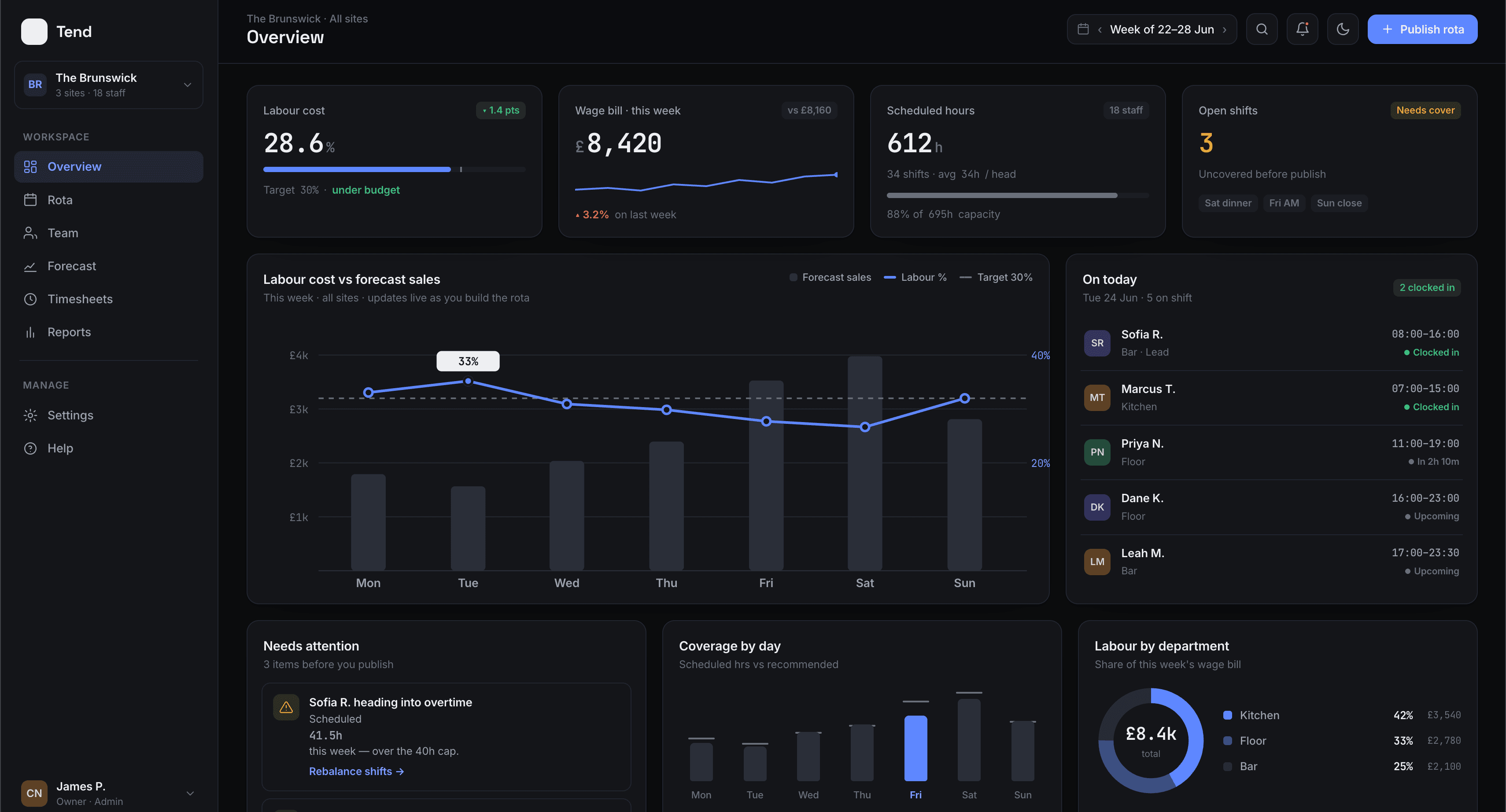
Tend is an original product Charged Studio designed end to end, a scheduling platform built for the owner-operators and general managers of independent cafés, bars, and small restaurant groups. Most scheduling tools treat the rota and the money as two separate problems: you build the week in one place, then find out what it cost you somewhere else, usually too late to do anything about it. Tend collapses that gap. Every shift you drag onto the grid updates a single, honest number in real time: labour cost as a percentage of forecast sales. The result is a tool that doesn't just help you fill the week, it helps you afford it.
The problem
Independent hospitality runs on margins thin enough to disappear in a single badly-planned week. Labour is the largest controllable cost in the building (typically 28–35% of sales), and the one most owners manage with the least visibility. In practice the rota gets built in a spreadsheet or a WhatsApp group, and the true cost of those decisions doesn't surface until the payroll run, by which point the money is spent. Cost is invisible at the point of decision, demand and staffing are disconnected, and the admin is relentless, so the same mistakes repeat every week.
“I don't find out if I got the rota right until I've already paid for it being wrong.” Owner of a three-site coffee group, early research
Who it's for
The primary user is the owner-operator, running one to three venues, 8 to 40 staff, hospitality-trained rather than finance-trained, who cares about labour percentage but has never had a tool that made it legible in real time. The general manager builds and publishes the rota on their behalf and lives in the tool daily, needing speed inside a budget someone else set. The staff member just wants to know when they're working, get paid right, and swap a shift without a guilt-trip, so Tend's staff-facing app is deliberately thin and the depth lives where the manager works.
The solution
Tend reframes scheduling around a single principle: the cost of a decision should be visible at the moment you make it. It makes labour cost a live number that moves as you plan and colour-codes against target, so you correct before you publish, not after you pay. It forecasts the week from sales history, day of week, and local signals like weather and nearby events, then suggests the cover each shift needs. And it takes the admin off the owner's plate: availability, time-off, one-tap swaps, and compliance guardrails all flow straight into the grid, with approved hours exporting clean to payroll.
Key features
Live labour-cost meter
A persistent read on cost vs. forecast sales, updating with every change to the rota and colour-coded against target.
Drag-and-drop rota grid
Build the week visually. Costs, hours, and compliance recalculate instantly as shifts move.
Demand forecasting
Per-daypart predictions from sales history, seasonality, weather, and local events, translated into a recommended level of cover.
Availability & time-off
Staff set availability and request leave in-app; it lands in the grid automatically, so you never roster someone who can't work.
One-tap shift swaps
Staff arrange cover between themselves; the manager approves with a single action and the rota and costs update.
Compliance guardrails
In-the-moment warnings for overtime, rest breaks, and under-18 hour limits, caught while building, not discovered at payroll.
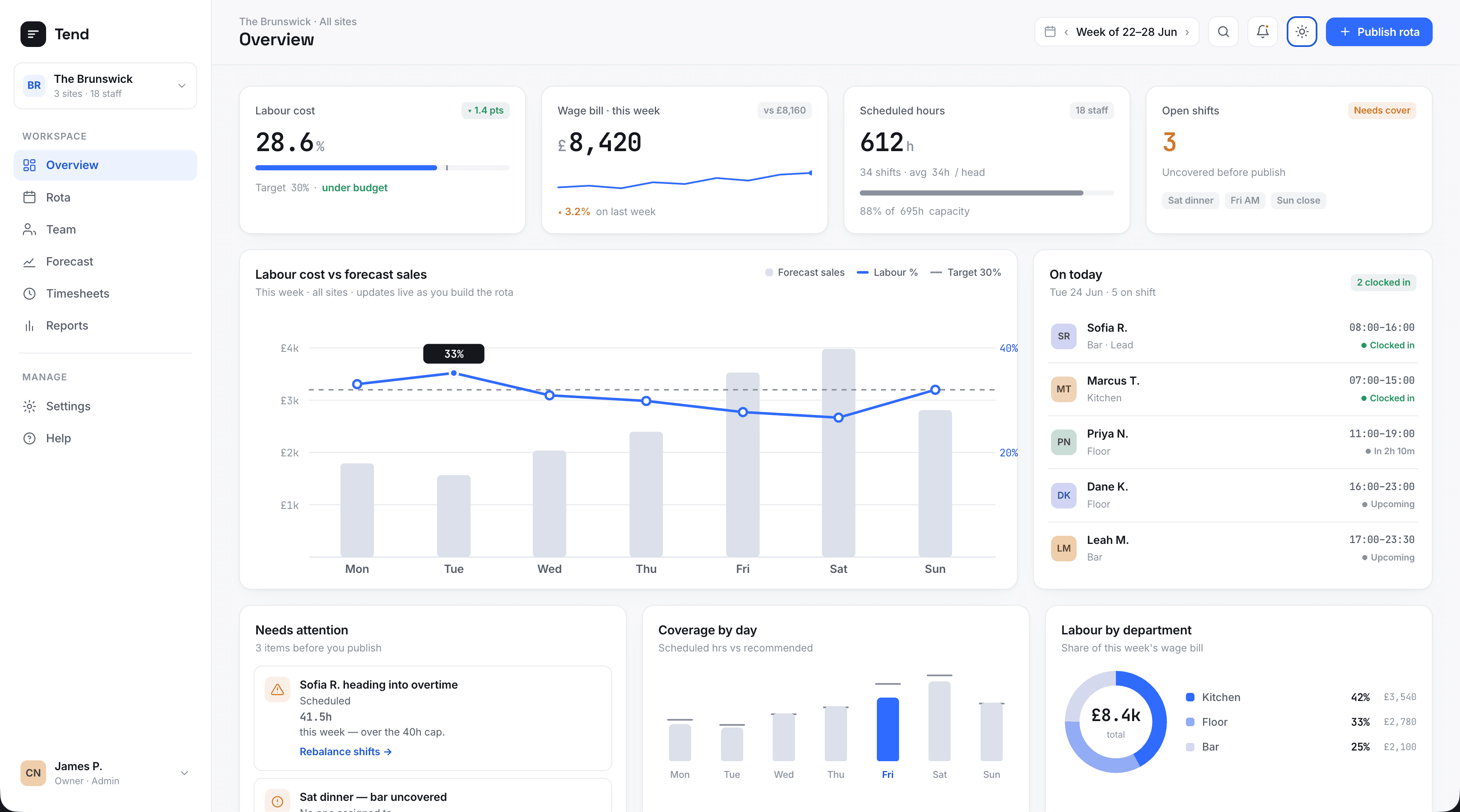
Built on design tokens from the start: light and dark, both first-class.
The design solution
The interface had one job: make a financial tool feel as quick and unintimidating as a calendar, for someone who never asked to think like an accountant. A tight neutral grey scale, hairline borders, one confident accent used only where it earns attention, and tabular mono numerals let the figures read like data. The dashboard leads with the four numbers an owner actually checks (labour percentage, wage bill, scheduled hours, open shifts), then puts forecast sales and labour cost on the same axis, so the relationship the whole product exists to expose is the first thing you see. Alerts are reserved for genuine decisions, so the interface stays calm and the warnings carry weight.
Outcome
Tend demonstrates Charged Studio's approach end to end: framing a real operational problem, defining the people it affects, and resolving it into a product with a clear point of view and a finished, production-grade interface, not a wireframe, but something that looks and behaves like a product you could ship.
Ready to grow your business?
Tell us what you need, or grab a free audit of your current site. We'll get back to you within one working day.